



Experience Sharing on Troubleshooting of the Hongtong Purified Water Preparation System
- GangTong
- 2026-02-27
The purification water system is of vital importance in pharmaceutical factories, serving as the core infrastructure for ensuring the quality, safety, and compliance of drugs. If it fails, it not only affects the production progress but also may lead to product scrapping due to non-compliant water quality, resulting in significant economic losses. Today, Hongtong Company, based on over 30 years of research and operation experience in purification water systems, has compiled the following step-by-step troubleshooting techniques for the most common cases of不合格 electrical conductivity. These techniques will help you quickly identify the problem and solve it efficiently, avoiding unnecessary downtime!
Fault phenomenon:
The conductivity of the produced water is higher than 5.1 µS/cm (25℃), which exceeds the GMP requirements and affects the compliance of subsequent product production.
Troubleshooting steps:
1. Check the quality of the raw water: Test the TDS value, hardness, and microorganisms in the raw water to see if they are超标 (polluted raw water may cause excessive load on the pre-treatment system). If the raw water quality is abnormal, it is necessary to first treat the raw water (such as increasing the processing capacity of the pre-treatment system and adjusting the dosage of sodium hypochlorite to inhibit microorganisms).
2. Check the operation time and pressure difference of the multi-media and activated carbon filters and softeners (if the pressure difference is greater than 0.05 Mpa, it indicates blockage and requires backwashing. The multi-media filter needs to be replaced every 3-5 years, and the activated carbon filter needs to be replaced every 1-2 years. After saturation, the activated carbon cannot remove chlorine, and the resin of the softener needs to be replaced every 3-5 years). Open the manhole to check if the multi-media filter, activated carbon filter, and softener filter are clogged, blackened, or if the activated carbon has no adsorption capacity, or if the softener has no displacement ability.
3. Check the filter element of the security filter if it is blocked, damaged, has impurities on the surface, aged sealing ring, or not properly installed (it is recommended to replace it every 3-6 months).
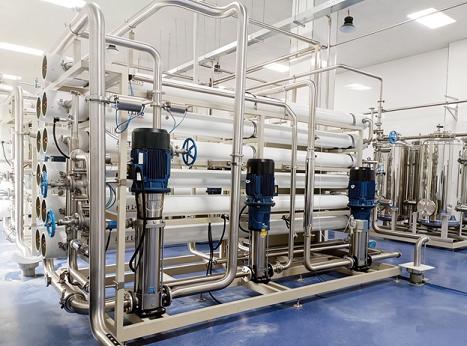
4. Check the reverse osmosis (RO) membrane: Check the sealing parts at both ends of the membrane housing for leakage, aging, and damage, whether the membrane assembly is installed incorrectly, and whether the end cover is not tightened; check if the RO membrane is damaged (this can be determined by changes in the production water flow rate; replacement is required if damaged); check the usage duration of the membrane assembly, with a conventional RO membrane having a lifespan of 3-5 years; if it exceeds this period, it is due to natural aging.
5. Check the EDI module: Check the working parameters of the EDI, confirm if the voltage (300-600V) and current are within the design range, and check if there is a low voltage (decreased desalination capacity); check the concentrated water chamber for white scale (calcium, magnesium ions / silicon scale), and whether the concentrated water flow rate is ≥ 30% of the designed value (low flow rate is prone to scaling); check the wiring of the EDI electrode plates for looseness, oxidation, and water accumulation in the electrode chamber (short circuit); if the EDI module is aged, contact the manufacturer for replacement.
6. Check for pipe contamination: Check if microorganisms have grown in the purified water delivery pipeline (regular CIP cleaning is required); check for cracks at pipe welds, aging sealing rings of quick-connect joints (air entering will affect the resistivity).
The core principle of troubleshooting the purification water preparation system follows the "first qualitative, then locate, first the front end, then the rear end, first physical, then chemical, and immediate compliance" principle, covering four core units: pre-treatment, RO reverse osmosis, EDI, and water storage and circulation pipelines. It also takes into account water quality protection, equipment protection, and record traceability during the troubleshooting process, ensuring both quick problem identification and resolution, and avoiding secondary pollution, equipment damage, or compliance loopholes during the troubleshooting operation.
The stable operation of the purification water system is the core foundation for production compliance and water quality standards. The core of troubleshooting is always "prevention is better than cure". We hope this practical guide can provide effective reference for your daily operation and maintenance, and ensure regular maintenance and compliance control throughout the process, so that the system has fewer faults and continues to meet standards.
Gangtong Medical Group Pharmaceutical Equipment (Hebei) Co., Ltd
Copyright: Gangtong Medical Group Pharmaceutical Equipment (Hebei) Co., Ltd
Website: http://www.hbgtzyzb.com
Group • Headquarters
Address: No. 356, South Section of Kailiwei Industrial Avenue, Jianyang City, Chengdu, Sichuan Province
Telephone: 028-27125617
Group • Shijiazhuang
Address: Tianshan Chuangke Intelligent Manufacturing Industrial Park, Zhao County Economic Development Zone, Shijiazhuang City, Hebei Province
Telephone: 13903311661